Our job isn't done when the truck leaves the site. Here's how to protect your concrete through Midwest winters, summers, and everything between — from the first week of curing to year twenty.
Tell us what your concrete needs — we'll call you back within one business day.
Keep foot traffic light and vehicles off new concrete. No deicing salt, no pressure washing yet — the slab needs to cure before it can take on daily use.
Especially in hot weather, water the surface down a few times a day for the first couple of days. Curing concrete needs moisture to gain strength — if it dries out too fast in the heat, it can crack or cure weak.
Rinse with water if needed. Hold off on detergents, degreasers, and pressure washing until the concrete has cured for a full 28 days.
We mix an integrated sealer into the concrete itself, so there's no separate sealing visit and no bare window where the surface is unprotected. You won't need to reseal for at least 3 years.
Use calcium chloride or sand instead of rock salt or ammonium-based deicers, which attack the surface and accelerate scaling and pitting.
Because every pour includes an integrated sealer, most driveways and patios won't need resealing for at least 3 years. Stamped and decorative surfaces should still get checked first, since color sealers wear faster.
Hairline cracks are normal. Widening cracks and failed control joints should get caulked or repaired before water gets in, freezes, and does real damage.
Chicago-area concrete goes through more freeze-thaw cycles each winter than almost anywhere else in the country. Water works its way into the pores of the slab, freezes, expands, and pushes the surface apart — a process known as scaling or spalling. Add road salt and calcium chloride into the mix, and untreated concrete can show real damage within just a few winters. Out here, maintenance isn't optional — it's the difference between a driveway that lasts ten years and one that lasts thirty.
Sealed concrete resists water intrusion. Unsealed concrete lets water in, freeze, expand, and crack the surface from the inside out — winter after winter.
Rock salt and ammonium-based deicers accelerate surface scaling. Our integrated sealer blocks chloride penetration from the day we pour, with no gap before a separate coat gets applied.
Snowmelt and spring rain saturate unsealed concrete right before overnight refreezes — the single hardest stretch of the year on an unprotected slab.
Stamped, stained, and exposed-aggregate concrete look better than a standard slab — and they need more attention to stay that way. The color and texture live in a thin surface layer, and that layer is exactly what takes the abuse from UV, salt, and foot traffic.
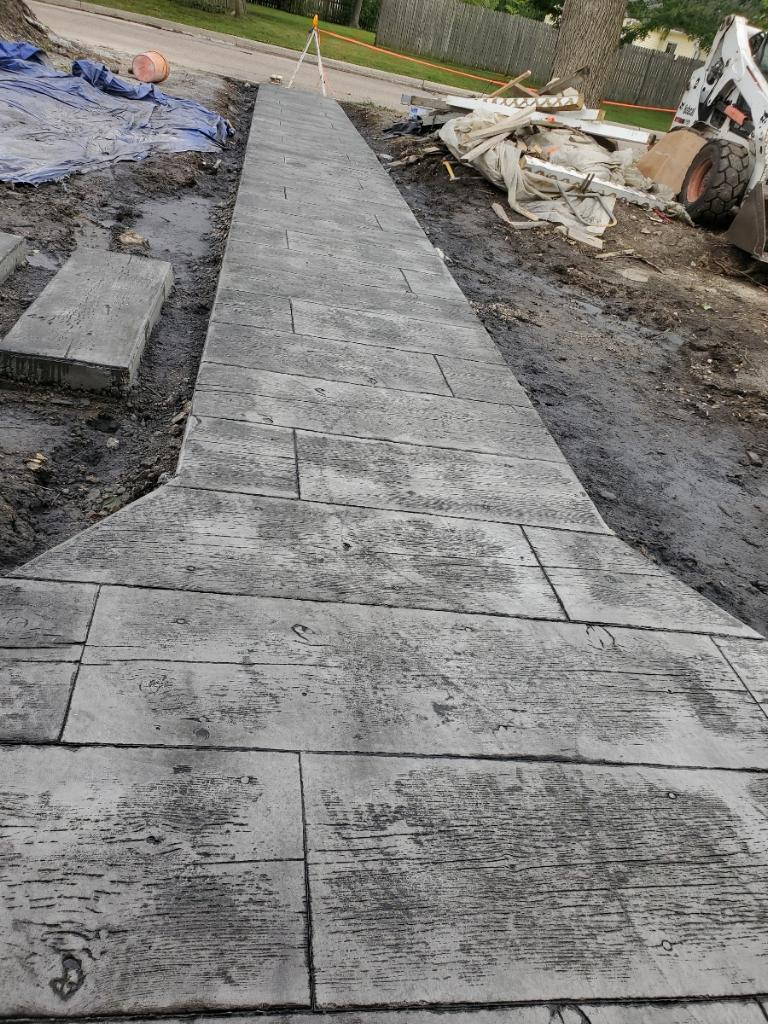
Every pour includes an integrated sealer, so stamped and decorative concrete is protected from day one — no bare window before a first coat. Most surfaces won't need resealing for at least 3 years.
Metal shovels and ice picks chip stamped texture; rock salt and ammonium deicers eat through color sealer. Use a plastic shovel and calcium chloride or sand instead.
The white, chalky bloom that appears on stamped concrete is mineral deposits pushed up by moisture — common after Midwest freeze-thaw cycles. It's cosmetic, but it signals the sealer needs attention.
Sealers can get slick when wet, especially around pools, patios, and entries. We reapply a slip-resistant additive during resealing on high-traffic and wet-prone areas.
Direct sun fades color sealers over the years. A color-enhancing reseal restores the original tone without repouring the slab.
Whether it's a first-time sealing, a stamped patio touch-up, or a pre-winter inspection, we'll take a look and tell you exactly what it needs — nothing more.
Call (708) 955-8265